On July 23, 1974, Colonel Clay Beattie, Commander of the Canadian Contingent in Cyprus, took a blue and white UN flag and placed himself between attacking Turkish forces and Greek National Guards fighting over possession of the Nicosia International Airport. His action led to a ceasefire.
Shortly thereafter, elements of the Canadian Airborne Regiment occupied the airport and when word of an impending second attack reached the Canadians, they made it clear to the Turks that any advance would be interpreted as a hostile act against UN troops and would be met with force. The bravado, made creditable by the professionalism of the Canadians, worked and despite vastly superior numbers and firepower, no attack materialized.
Thus started a new style of peacekeeping, characterized by active intervention between opposing sides rather than passive occupation of the ground between them. It came at a high cost with more than 20 Canadian dead and wounded. With their only mandate from UN HQ in New York to "play it by ear," Beattie tells the story of how this small force rewrote the peacekeeping rulebook.
The Bulletproof Flag is the full account of the 1974 Turkish invasion of Cyprus and the war that followed. It details the behind-the-scenes political intrigue, the multi-national UNIFCYP peacekeeping contingents, and the actions of the remarkable men of the Canadian Airborne Regiment. It is told, as only he could tell it, by the man that was on the ground as both UN Chief of Staff and Commander of the Canadian Contingent.
Much of what you will read in this book has never before been told and certainly not with the bullet-by-bullet impact of Clay Beattie's The Bulletproof Flag.
On July 23, 1974, Colonel Clay Beattie, Commander of the Canadian Contingent in Cyprus, took a blue and white UN flag and placed himself between attacking Turkish forces and Greek National Guards fighting over possession of the Nicosia International Airport. His action led to a ceasefire.
Shortly thereafter, elements of the Canadian Airborne Regiment occupied the airport and when word of an impending second attack reached the Canadians, they made it clear to the Turks that any advance would be interpreted as a hostile act against UN troops and would be met with force. The bravado, made creditable by the professionalism of the Canadians, worked and despite vastly superior numbers and firepower, no attack materialized.
Thus started a new style of peacekeeping, characterized by active intervention between opposing sides rather than passive occupation of the ground between them. It came at a high cost with more than 20 Canadian dead and wounded. With their only mandate from UN HQ in New York to "play it by ear," Beattie tells the story of how this small force rewrote the peacekeeping rulebook.
The Bulletproof Flag is the full account of the 1974 Turkish invasion of Cyprus and the war that followed. It details the behind-the-scenes political intrigue, the multi-national UNIFCYP peacekeeping contingents, and the actions of the remarkable men of the Canadian Airborne Regiment. It is told, as only he could tell it, by the man that was on the ground as both UN Chief of Staff and Commander of the Canadian Contingent.
Much of what you will read in this book has never before been told and certainly not with the bullet-by-bullet impact of Clay Beattie's The Bulletproof Flag.

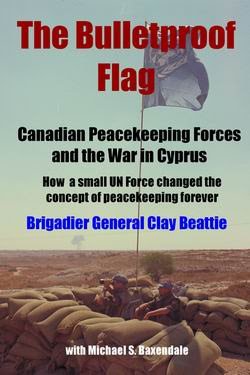 Image 1 of 1