
Operation Epic Fury and Iran’s Opposition Movement: A Resistance Tests Its Moment
Does the future of democracy in Iran lay with the NCRI?
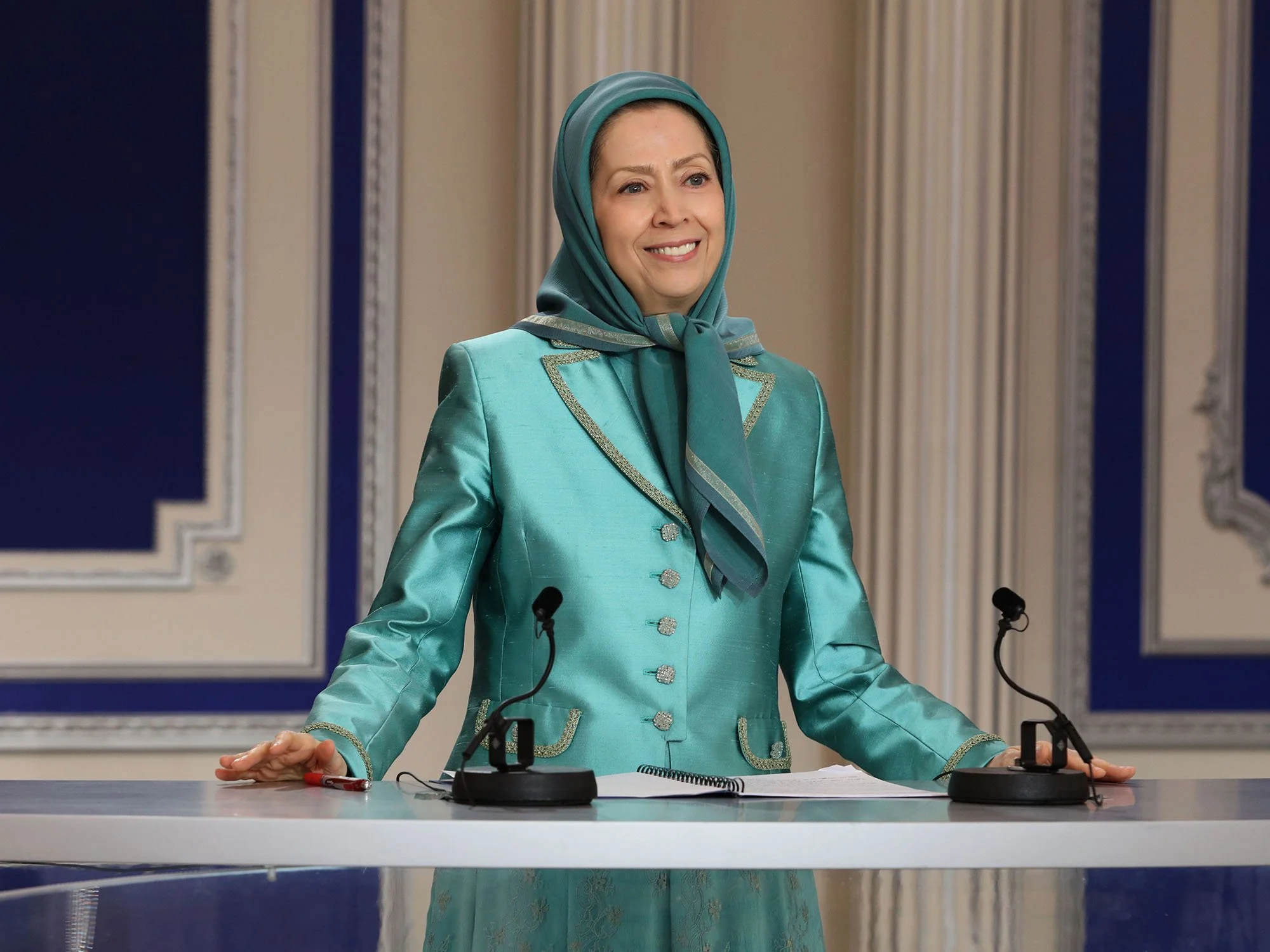
Maryam Rajavi, President-elect of the National Council of Resistance of Iran, has long advocated for the overthrow of the Iranian regime. Now, she may stand to inherit the task of bringing democracy to the nation. From March 5th global townhall featuring prominent parliamentarians and diplomats.
PARIS — As Operation Epic Fury unfolds across Iran, the strategic and political consequences are already reverberating far beyond the battlefield. Launched on February 28, 2026, coordinated strikes by the United States and Israel targeted military installations, missile infrastructure, leadership compounds, and key elements of Iran’s nuclear program. Washington framed the operation as a decisive move after diplomacy had been exhausted, arguing that Tehran was advancing toward nuclear weapons capability while continuing to develop long-range missiles and drones and directing proxy attacks against U.S. and allied interests across the Middle East.
From the American strategic perspective, the campaign carries several core objectives: preventing a nuclear-armed Iran, dismantling its ballistic missile and drone strike networks, and reducing the ability of the Islamic Revolutionary Guard Corps (IRGC) to threaten U.S. forces and regional partners. In the opening phase alone, U.S. military reporting indicated that nearly 2,000 targets were struck within the first 100 hours, involving more than 50,000 American personnel and assets ranging from carrier strike groups to long-range bombers and advanced drones. With an estimated price tag of $3.7 Billion US many think it is a bargain relative to the pain that would have been inflicted should they have acquired hypersonic missile capability from China or nuclear warheads. The targets included air-defence systems, missile storage facilities, naval bases, and IRGC command-and-control networks, in what U.S. officials described as a multi-domain campaign extending “from seabed to space and cyberspace.”
One of the most consequential developments came early in the operation with the killing of Supreme Leader Ayatollah Ali Khamenei during strikes on Tehran, an event widely interpreted by analysts as a decapitation blow to the regime’s leadership structure and a potential catalyst for political transformation inside Iran. Iranian forces have retaliated with missile and drone attacks against Israel, U.S. bases in the Gulf, and regional allies including Bahrain and Kuwait, raising the risk of further escalation across the Middle East.
In Washington and among supporters of the operation, the campaign is framed as both defensive and preventative: an effort to halt nuclear proliferation, weaken an authoritarian theocratic regime, and protect democratic allies in the region. President Trump has explicitly called on Iranians to “take over your government,” casting the operation as directed at the ruling regime rather than the Iranian population itself. Yet even inside the United States, the operation has sparked debate, with some lawmakers arguing that such large-scale military action requires explicit congressional authorization.
Against this rapidly shifting geopolitical backdrop, Iran’s organized opposition is seeking to frame the moment as a turning point.
NCRI spokespeople address crowds in Paris after the announcement of the death of Supreme Leader Ali Khamenei.
Speaking in Paris yesterday, Maryam Rajavi, leader of the National Council of Resistance of Iran (NCRI), argued that while military pressure may weaken the regime, the decisive force shaping Iran’s future must come from inside the country itself.
“The overthrow is possible only by the people of Iran and their organized resistance,” Rajavi said.
Her address positioned the NCRI and its core movement, the People’s Mojahedin Organization of Iran (MEK), as the organized force capable of translating unrest inside Iran into political change. But the organization does have a long past and in 1997 former United States Secretary of State Madeleine Albright had them designated as a terrorist organization for encouraging dissent against the Mullahs. Hoshim Gobadi the NCRI spokesperson was interviewed and said this was part of the Clinton’s administration to curie favour with the radical Islamic movement. After US-Iranian allegiances shifted dramatically following the Clinton administration, the NCRI won a series of court battle culminating in 2012 which officially removed the designmantion. The NCRI has since been recognized by western governments as a leading voice towards the establishment of a democratic, secular Iranian republic.
Speaking on the state of the Ayatollah’s government, Rajavi described a regime increasingly reliant on intimidation to maintain control, including threats against the Iranian opposition abroad and warnings of missile attacks against the MEK’s headquarters at Ashraf-3 in Albania.
But she argued that repression reflects deeper instability within Iran’s political system.
According to Rajavi, the leadership surrounding the remnants of Khamenei’s system has been discussing the creation of a temporary leadership council to stabilize the regime. At the same time, she said, the government continues to rely on coercion to prevent the emergence of a new wave of popular unrest.
“The January uprising in Iran was not extinguished despite the regime’s bloody crackdown,” she said. “It will return with a far stronger force against this regime.”
Maryam Rajavi, President-elect of the National Council of Resistance of Iran, has long advocated for the overthrow of the Iranian regime. Now, she may stand to inherit the task of bringing democracy to the nation. From March 5th global townhall featuring prominent parliamentarians and diplomats.
Central to her argument is the role of so-called Resistance Units, decentralized networks linked to the opposition that she says operate inside Iran. In recent days, Rajavi said, these units have increased their activities and targeted institutions used to suppress the population.
“These activities carry an important message,” she said. “There is an active force on the ground in Iran. It is organized and capable of organizing. It is willing to make sacrifices, and in combination with the uprising, it can achieve the overthrow of this regime.”
Rajavi also highlighted the NCRI’s proposal for a provisional government, announced on February 28, designed to oversee the transfer of sovereignty to the Iranian people following the fall of the current regime. Under the plan, a transitional authority would hold free elections within six months to form a constituent assembly responsible for drafting a constitution for a democratic republic.
“We are fighting to establish a republic based on freedom and democracy, the separation of religion and state, pluralism, and gender equality,” Rajavi said.
Central to the NCRI’s claim that it represents a viable democratic alternative is Maryam Rajavi’s Ten-Point Plan, first articulated as a framework for a post-Islamic Republic political order. The plan begins with the rejection of velayat-e faqih, the system of absolute clerical rule and the establishment of a republic based on universal suffrage and political pluralism. It calls for guarantees of fundamental freedoms including freedom of speech, political parties, assembly, press, and the internet. The proposal also commits to dismantling the security architecture that has sustained the Islamic Republic’s internal control, including the Islamic Revolutionary Guard Corps (IRGC), the Basij militia, and the Ministry of Intelligence, institutions widely associated with repression of dissent.
The program further promises civil liberties aligned with the Universal Declaration of Human Rights, including the abolition of torture and the death penalty and justice for political prisoners executed under the regime. Rajavi’s proposal also places strong emphasis on the separation of religion and state, the independence of the judiciary, and the dismantling of Iran’s revolutionary courts, replacing them with a legal system based on international standards and due process.
Another pillar of the plan is gender equality and minority rights, including equal participation of women in political leadership and protections for Iran’s ethnic communities. The framework also outlines a market-based economy with equal opportunities for workers, farmers, and entrepreneurs, environmental rehabilitation, and a non-nuclear Iran committed to regional peace and cooperation. For NCRI supporters, the Ten-Point Plan is meant to demonstrate that the opposition movement has not only a revolutionary objective but also a defined blueprint for democratic governance after the fall of the current regime.
But probably more importantly it supports Israel’s right to exist through their policy to recognize all nations and to set up diplomatic relations. “We will establish relations with all countries. We reached out to Global Affairs Minster, Anita Anand and requested comment at to whether Global Affairs Canada was in any discussions with the NCRI or would they recognize their claim as the legitimate government in exile. They have not provided any comment as of publication.
Support for the NCRI’s political program was echoed by several Western figures attending the gathering in Paris. Former U.S. Under Secretary of State and Ambassador Robert Joseph, along with former Welsh Tory parliamentarian David Jones, expressed support for the NCRI’s Ten-Point Plan, describing it as a framework for a peaceful and democratic transition in Iran based on secular governance, free elections, and equal rights.
NRCI supporters flock to the streets in Paris calling for regime change.
Yet despite the unfolding war and growing international pressure on Tehran, Rajavi emphasized that Iran’s political future cannot be imposed from outside.
“Only the people of Iran have the legitimate right to determine the political future of their country,” she said. “No future for Iran can be created from outside.”
For the NCRI, the convergence of regional war, internal unrest, and international pressure represents a moment of historic possibility, one in which Iran’s opposition hopes to demonstrate that it is more than an exile movement.
“It has demonstrated that it is the only alternative to Mullahs or a Shaw. The entire world owes the NCRI for its contribution to bringing the facts to governments and media for the past two decades said former Welsh politician Jones.
It is, Rajavi said, “an active force on the ground.”
President Donald J. Trump has stated that Regime Change was not an explicit operational objective, but Trump and his administration have certainly created the opportunity for the people to take back Iran.
May democracy prevail and may peace in the Middle East finally be realized.